How to Rotate Cigars in a Humidor
A humidor is not a static box. Even when your hygrometer reads a perfect 70% and your temperature holds steady, the cigars inside are sitting in slightly different microclimates depending on where they are. The ones nearest the humidification source are taking on more moisture. The ones at the back, tucked behind two rows of robustos, are getting less air. Left alone for months, this small inequality compounds into a real problem: some cigars draw beautifully, others feel spongy, and a few have dried out without you noticing.
Rotation fixes that. It is the single cheapest piece of cigar maintenance you can do, and it costs you about ten minutes every few weeks.
Why does rotating cigars actually matter?
Tobacco is hygroscopic, meaning it absorbs and releases moisture continuously based on its surroundings. Inside even a well-built humidor, humidity is never perfectly uniform. There are pockets, gradients, and dead zones. A cigar resting directly above a Boveda pack is going to behave differently from one wedged in a corner three inches away.
Over time, those small differences become flavor differences. Cigars that have absorbed too much moisture will burn unevenly, tunnel down the middle, and taste muted. Cigars that have lost moisture become harsh and tight. Rotation gives every cigar a roughly equal share of the humidor's conditions, which is what you want if you care about even aging of cigars across your collection.
There is also a flavor argument. Cigars exchange aromatic oils with the cedar lining and with each other when stored in close proximity, and a Maduro pressed against a mild Connecticut for six months will lend it some of its character. Rotation keeps that exchange controlled rather than accidental.
How often should you rotate cigars?
Every two to four weeks is the range most experienced collectors settle on. If your humidor is large, packed tightly, or sits somewhere with fluctuating ambient conditions, lean toward two. If it is small, lightly loaded, and kept in a temperature-stable room, monthly is fine.
You do not need a calendar reminder. A useful trigger is hygrometer maintenance: every time you check or recalibrate it, do a rotation while the lid is open. Pairing the two tasks means rotation never becomes the thing you keep meaning to do.
What you should avoid is opening the humidor purely to rotate, as the air exchange itself disturbs your humidity equilibrium. Combine the job with another reason to be in there.
What is the right way to rotate them?
There are a few approaches, and the one you choose depends on how your humidor is built.
-
For a flat single-tray humidor, the simplest method is top-to-bottom and front-to-back. Take the cigars from the upper layer and move them to the lower position; bring the bottom row up. Then shift the front cigars to the back, and the back to the front. You are essentially doing two perpendicular swaps in one motion.
-
For a multi-shelf cabinet, rotate by shelf. The top shelf usually runs slightly drier and warmer because heat rises, while the bottom shelf can collect humidity. Move the contents up or down one level each rotation, working in a cycle so that over the course of a few months every cigar has spent time at every elevation.
-
If you store by brand or vitola, keep groupings together but rotate them as units. There is no benefit to scattering a box of Padrons across the humidor; you just want each box to take its turn in the warmer and cooler zones.
Handle each cigar gently. The wrapper is the most fragile part of any cigar, and a careless thumb can crack it. Lift, do not drag. If a cigar feels noticeably softer or harder than the others around it, set it aside and pay attention to it; this is often the first sign of a humidity problem developing in one part of the box.
Should you rotate cigars in their cellophane?

Yes, leave the cellophane on if that is how they came. Cellophane is breathable, slows moisture exchange just enough to protect cigars at the edges of the humidor, and prevents wrapper damage during handling. It does not stop aging, despite what you may have read.
Boxed cigars present a different question. Some smokers age cigars in their original boxes, which is perfectly valid and actually helps marry the flavors within that box. If you do this, rotate the entire box rather than removing individual cigars. Open boxes, on the other hand, should have their contents handled the same way as loose singles.
What happens if you never rotate them?
Nothing dramatic, in the short term. A cigar left in the same spot for three months will not be ruined. But the longer it sits, the more pronounced the inequality becomes, and after a year you will have a humidor where some cigars are noticeably better than others despite being identical when you bought them.
The real cost is on long-term aging. A premium cigar laid down for five years to develop is worth the cost of an extra ten minutes of attention every few weeks. Without rotation, you might find that the box you have been waiting on has aged beautifully on one end and unevenly on the other.
Rotation is also when you notice problems. A cracked wrapper, a hint of mold, an underperforming hygrometer; you catch all of these earlier when you are regularly putting hands on your collection. Treat it as inspection time, not just maintenance.
A few habits worth building
Keep a small notebook or note app entry tracking when you last rotated and any issues you spotted. It sounds excessive until you have been collecting for a few years and cannot remember which boxes have been opened and which have not.
If you are buying cigars faster than you are smoking them, your rotation matters more, not less. A growing collection means cigars are spending longer in storage, which means small inequalities have more time to compound.
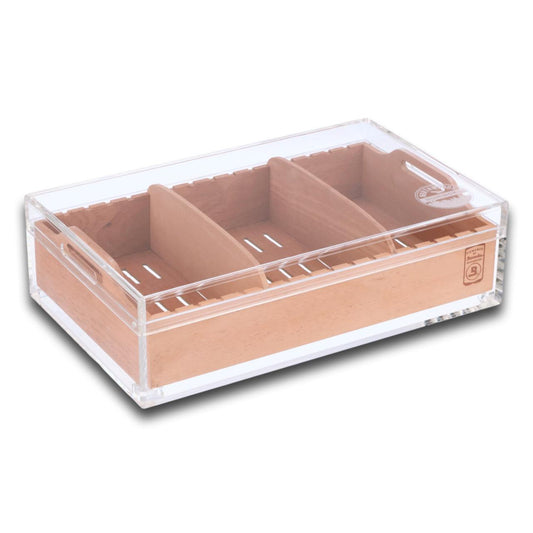
For collectors building a serious storage setup, you can discover designer cigar accessories that include hand-built humidors with internal architectures specifically designed to minimize the rotation burden, with airflow systems and shelving that distribute humidity more evenly than standard boxes.
A humidor is a working piece of equipment, not a display case. The collectors who get the most out of theirs are the ones who treat it that way: opening it with a purpose, paying attention to what they find, and putting in the small amount of work that keeps every cigar in the box pulling its weight.